The Road Out of Zürich

Bijgewerkt op: 13 sep
By Adrian Vance

There is a particular moment when leaving Zürich by car when the city begins to loosen its grip.
The streets are still familiar. Trams move through their morning routes, cyclists occupy the edges of the road, and traffic lights impose the usual rhythm of stop and start. For a while, leaving feels much like any other journey across the city.
Then the buildings begin to thin.
The road opens.
And Zürich quietly disappears behind you.
I like that transition.
Not because I have any particular desire to escape the city. Quite the opposite. Zürich is home, and one of the advantages of having a place that genuinely feels like home is that leaving it doesn't need to feel like an escape.
Sometimes it is simply good to drive.
The DB12 is particularly suited to mornings like this. There are faster ways to cover distance, and certainly more efficient ones. But efficiency isn't always the point. A train compresses the space between two places. Driving allows you to experience what lies between them.
Today, that is reason enough.
The route south-east from Zürich changes gradually rather than dramatically. Urban streets give way to smaller towns, the traffic becomes lighter, and eventually the landscape begins to determine the road rather than the other way around.
I pass Einsiedeln without feeling any urgency to stop.

There is no itinerary to satisfy and no list of places that need to be collected before lunch. The pleasure of having nowhere particularly important to be is that you can allow the road to establish its own pace.
The further I drive, the less attention the journey seems to require from the clock.
Perhaps that is one of the reasons I enjoy driving.
Most forms of modern travel are designed around eliminating the time between departure and arrival. We measure them by how quickly, comfortably or reliably they make the intervening distance disappear.
A good road does the opposite.
It makes the distance worthwhile.
By the time the landscape opens around Sihlsee, the city feels considerably further away than it actually is.
The lake appears almost without ceremony.

Water stretches across the valley, surrounded by slopes that are beginning to carry the first signs of autumn. Farmhouses sit apart from one another on the hillsides. The mountains rise beyond them in successive layers, softened slightly by the morning haze.
Nothing about the view demands attention.
It simply receives it.
The scale changes everything.
The car, which felt substantial on the streets of Zürich, suddenly becomes a very small object moving through a much larger landscape. Roads curve along the water and disappear behind fields and trees. What looked like a destination on a map becomes just another part of the journey.
This is the Switzerland I find myself returning to most often.
Not necessarily the spectacular viewpoints or the places that announce themselves as destinations, but the spaces between them. A road beside a lake. A village passed without stopping. A mountain appearing gradually through the windscreen.
There is a tendency to think that meaningful travel requires distance.
Living in Zürich has made me increasingly unconvinced of that.
Some of the most effective changes of perspective happen surprisingly close to home.
Beyond Sihlsee, the road begins to climb.
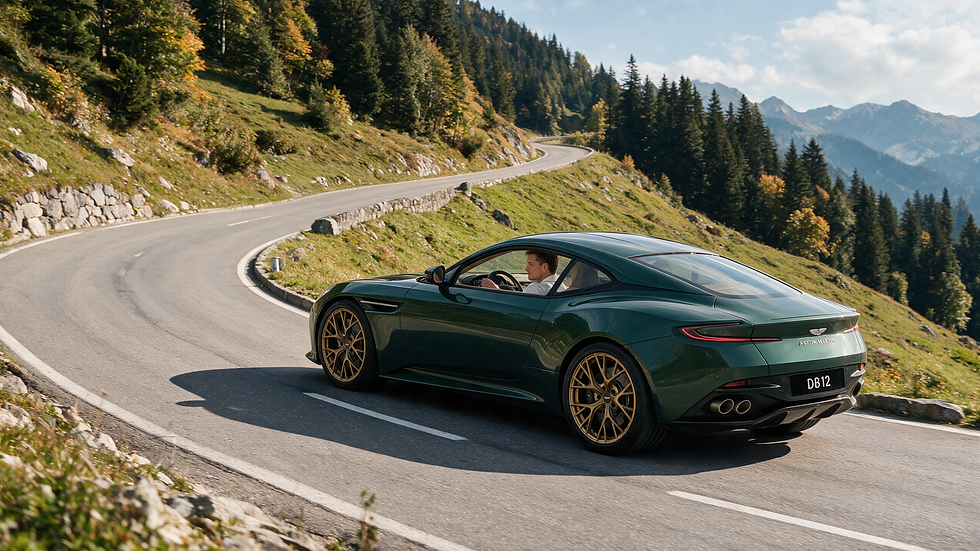
The landscape closes in again as the route towards Ibergeregg becomes narrower and more deliberate. Long open stretches give way to bends. Forest appears
closer to the road.
The gradient changes. Driving stops being something happening in the background and becomes the activity itself.
This is where a car like the DB12 makes sense to me.
Not as an object to be displayed, and not because every road needs to become an occasion for performance. Quite the opposite.
A good grand tourer should make you want to continue.
There is satisfaction in a car that can leave the city without drama, cover distance
comfortably and then become more communicative when the road begins to ask something of it. The steering wheel requires a little more attention. The next corner matters. You begin looking further ahead.
Speed has very little to do with it.
Rhythm does.
Brake. Turn. Let the road open. Accelerate. Settle again.
There is something pleasantly absorbing about having only the next section of road to consider.
No notifications. No meetings beginning in six minutes. No reason to divide attention between several things at once.
Just the road, the car and whatever appears around the next bend.
Eventually the trees break apart and the mountains return.
I don't stop because I have reached some carefully selected endpoint. There is no real achievement in arriving at Ibergeregg, and turning a quiet morning drive into a conquest would rather miss the point.
I stop because, for a moment, it feels unnecessary to keep moving.
The engine goes quiet.
Without it, the scale of the landscape becomes apparent again.
A few hours earlier I was moving through Zürich among trams, bicycles, pedestrians and the familiar choreography of a city beginning its day. Now there is wind moving through the grass, the occasional sound of another car somewhere below, and mountains occupying most of the horizon.
The distance between those two worlds is remarkably small.
That may be what I value most about this road.
It doesn't take me away from my life. It gives me enough distance to see it differently.
Sooner or later, I will turn the car back towards Zürich. The mountains will recede, the roads will straighten, traffic will return and eventually the first tram lines will appear again.
And I will be pleased to see them.
The best roads out of a city, I've found, are often the ones that make you appreciate the road back.

Opmerkingen